
Transcript
Announcer:
You’re listening to NeuroFrontiers on ReachMD, and this episode is supported by UCB. Here’s your host, Dr. Alexandria May.
Dr. May:
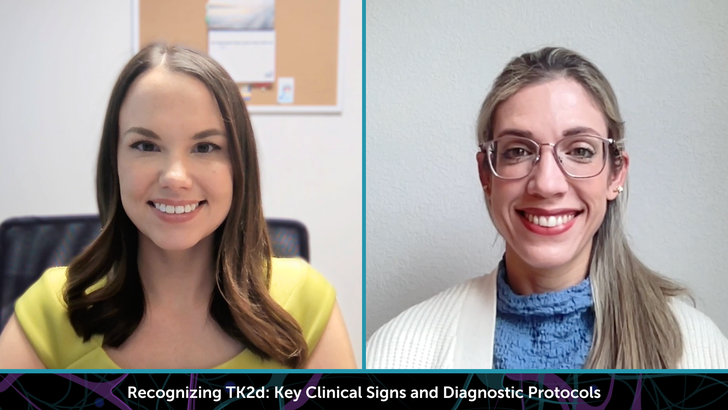
This is NeuroFrontiers on ReachMD, and I'm Dr. Alexandria May. Joining me to examine how we can better recognize thymidine kinase 2 deficiency, or TK2d for short, in neurology practice is Dr. Kaitlin Batley. She's the Director of the Pediatric Neuromuscular Program at Children's Health and an Assistant Professor of Pediatrics and Neurology at UT Southwestern Medical Center. Dr. Batley, welcome to the program.
Dr. Batley:
Thank you so much. I'm thrilled to be here.
Dr. May:
Now, for some context, fatigue and progressive muscle weakness are among the most common complaints in neurology. But in some patients, they reflect an underlying mitochondrial disorder like TK2d. From your perspective, Dr. Batley, what tends to raise your suspicion that something more than a typical neuromuscular condition may be at play here?
Dr. Batley:
I think when you're considering the diagnostic workup and a patient presents with something like fatigue and muscle weakness, it's important to really do a thorough whole-system analysis. So this is where we ask questions that are outside of the typical neurology field, and instead, we're asking about things like breathing problems. How do they sleep at night? Are there constipation or GI issues? And we're really assessing the entire body as a whole. When we do see that patients are presenting with multi-systemic complaints and issues in other organ systems, that's where we can really think, could a mitochondrial disorder be the underlying etiology here? And I think it's important to give that whole well-rounded assessment in order to point us in that direction.
We also know that this diagnostic workup can be sometimes ruling out certain things. And so maybe if we're ruling out some of the more common conditions and the things that we see more frequently, then we need to dig a little bit deeper and continue to further our assessment until we do come at a diagnostic conclusion.
Dr. May:
And if we look more closely at TK2d, recurring patterns include progressive limb-girdle weakness, axial involvement like dropped head syndrome, and often early or disproportionate respiratory muscle weakness. So how do these features come together in a way that raises concern for TK2d?
Dr. Batley:
That's a great question, and I think when we are faced with the chief complaint of progressive limb-girdle pattern muscle weakness, the complaint is relatively nonspecific, and we know this can be caused by a wide variety of neuromuscular conditions—ranging from limb-girdle muscular dystrophies to spinal muscular atrophy and even more.
And so I think it really comes down to piecing together the other aspects of symptoms that a patient might have. And some of those can be a little bit more specific for TK2d. And one of those I think, in particular, is early and severe respiratory involvement. And so we often see that respiratory impairment is out of proportion to muscle weakness and can be a really impactful symptom. And so when we do see a patient that is having whatever their respiratory presentation might be—from frequent respiratory infections to trouble sleeping at night with frequent nighttime awakenings or even development of respiratory failure—we know that this, when combined with skeletal muscle weakness, can really point us towards a smaller subset of conditions, and one of them is TK2d.
And then when we also think about a less common feature like dropped head syndrome, that can further support evidence pushing you towards TK2d and makes that red flag in the back of your mind to really assess completely for this condition.
And I think one of the things that can further make this even more challenging is that the disease presentation can really vary across the lifespan. And so we have some individuals who present with a very severe early-onset phenotype whereby they might have respiratory muscle failure and respiratory failure from birth or shortly afterwards, all the way towards the adults who might present with a more mild phenotype whereby they have this kind of indolent or slowly progressive disease whereby they may not have really realized that these symptoms are creeping up on them.
And so in assessing for respiratory muscle weakness, I think it's important to also communicate with colleagues like your pulmonologist whereby if they identify a patient who they're seeing for this severe respiratory impairment and they’re noticing maybe some muscle weakness on their exam, they're able to communicate with you and really form that connection so that way we can improve our diagnostic process.
Dr. May:
Now, these presentations can closely resemble conditions like spinal muscular atrophy or limb-girdle muscular dystrophy, so misdiagnosis is common. In your experience, where do we tend to go wrong when diagnosing patients, and what clues help us differentiate TK2d from those more familiar disorders?
Dr. Batley:
That's a great question, and I think it’s very important to remind us to continue searching until we have a conclusive answer. So we know, thankfully, these days that we have incredible genetic testing. It is widely available, and it is more in-depth than it ever has been before. And so it's very reasonable to first consider some of these more common conditions with common things being common, and to first rule those out.
But if you get to the point in your workup with a patient where you've crossed off SMA, you've crossed off the limb-girdle muscular dystrophies, and you don't have an answer yet, instead of giving just a clinical diagnosis, continue to pursue further testing, whether it's more in-depth genetic testing or things like muscle biopsy, so that way we can really get a clear and conclusive diagnosis.
And I think that having a high index of suspicion for conditions that do have some form of targeted treatment, like TK2d does now, is incredibly crucial. And so I know in my mind when I am performing my diagnosis, I'm really looking to assess for those conditions whereby I have an actual treatment beyond the important supportive care to prescribe and offer to a family. And so TK2d now goes on that short list and should be something that we're always keeping in the back of our mind.
Dr. May:
For those just tuning in, this is NeuroFrontiers on ReachMD. I'm Dr. Alexandria May, and I'm speaking with Dr. Kaitlin Batley about the clinical presentations and diagnostic challenges of thymidine kinase 2 deficiency.
Beyond skeletal muscle involvement, gastrointestinal features like dysphagia, delayed gastric emptying, and weight loss are other important aspects of TK2d, but they're often under-recognized. So, Dr. Batley, to what extent should these symptoms influence our suspicion when evaluating a neuromuscular presentation?
Dr. Batley:
I think when we're doing that initial assessment and we're screening with all of our multi-systemic questions, this is something that really does deserve to be further dug into. So for many of our patients, especially if they've been living with these symptoms for a long time or it's been that slowly progressive type of presentation, some of this might actually be their normal, like they've always had a little bit of trouble swallowing for a long time. And so it can be harder for them to bring this to you as a symptom of concern because it's something that they've always dealt with.
That's where we step in and ask pointed targeted questions to try to assess for these issues. And then again, recognizing that when we do see this other system involved, whether it's GI or respiratory, that's when we take it back and combine it with the skeletal muscle weakness and progressive myopathy and look for things like mitochondrial conditions, which we know can involve so many different organ systems.
And in addition to the questions that we ask our patients directly, I think it's also really important to use our diagnostic exam and other supportive information, things like weight trends. I'm a pediatric neurologist, and so I've got a growth chart that I look at every single time a patient comes into my office. And I'm watching to see them track along the growth chart, and if we see something like a plateau or a decline in weight, that can be a real signal to us that maybe there is gastrointestinal involvement—whether it's difficulty with swallowing that's causing them to eat less, fatigue when chewing that makes them finish their meal earlier, or delayed gastric emptying where they feel fuller and don't eat as much. That can be another clue that there is something going on that maybe a patient or their family hasn't even recognized yet.
And so again, it's looking at the entire body to find all of these little pieces of information that we can include together to make our diagnosis.
Dr. May:
Given these complexities, a structured evaluation that includes metabolic testing, muscle biopsy, and ultimately genetic confirmation becomes essential. Can you walk us through how you approach this workup in practice and where each step adds the most value?
Dr. Batley:
So it's a very interesting time to be a neuromuscular neurologist because we've really had such a shift in our diagnostic workup these days where we're starting with genetic testing. We know that this has the highest likelihood of having a concrete clear diagnosis and is easier to obtain. It is more cost effective, and many times, we can even get sponsored testing to allow our patients to access it. And so genetic testing is really where I first start my diagnostic workup when I have suspicion for some form of myopathy. And that can look differently depending on how targeted you want to start your approach, whether that's a single gene test, a panel of genes, or even something more broad like a whole exome or whole genome sequence, which would include mitochondrial DNA as well. And so that's truly where I start.
And then if there are any inconclusive results—maybe we get a variant of uncertain significance or maybe it is negative—then that's where we start to look to other testing modalities to really help support us in our diagnosis. Metabolic labs looking for things like elevations in lactate or abnormal amino acid profile can help point you towards mitochondrial diseases. And then muscle biopsies can be really helpful to pathologically assess the structure of the muscle and look for subtle changes that could indicate either a mitochondrial myopathy or dystrophic changes. And that can be especially impactful if you have something like a VUS on your genetic testing as that can be that extra layer to really help solidify the diagnosis.
Dr. May:
Looking at the bigger picture here before we close, Dr. Batley, how does earlier recognition change the trajectory of care and outcomes for patients with TK2d?
Dr. Batley:
I think early recognition is so impactful for patients and their families and can really change every direction of their care and the outcomes that we expect. We know if we're dealing with a particular condition, we can be proactive. We can assess what organ systems might need further assessment and where they might need more support. We can anticipate changes before they happen in order to provide the most targeted care that we can.
So for instance, if we know a patient has TK2d, we know they're at risk for respiratory impairment that's even out of proportion to their muscle weakness. We can then make sure that even if they say, ‘oh no, I'm breathing fine,’ we're really digging in and doing assessments to make sure that their respiratory function and their respiratory muscle strength is adequate. And if not, then we can start supporting them with things like airway clearance mechanisms or nocturnal ventilation. And in doing so, we can prevent complications, like a severe respiratory illness causing them to go into acute respiratory failure. And in doing so, it really improves quality of life and long-term outcomes.
We also know that as we develop disease-modifying therapies and we have new treatments available, we're able to start those hopefully early on to help either slow progression or mitigate complications from a particular disease. And then it also can be helpful for things like family planning to understand the inheritance pattern of this condition and have those discussions with our families.
And so overall, I think that one of the most important things we can do when we're seeing a patient for the first time is that full multi-systemic evaluation and then persistence in testing until a diagnostic conclusion is reached.
Dr. May:
Well, given the importance of earlier recognition, I want to thank my guest, Dr. Kaitlin Batley, for joining me to discuss the clinical signs and evaluation protocols for thymidine kinase 2 deficiency. Dr. Batley, it was great having you on the program.
Dr. Batley:
Thank you so much. It was my pleasure.
Announcer Close
This episode of NeuroFrontiers was supported by UCB. To access this and other episodes in our series, visit NeuroFrontiers on ReachMD.com, where you can Be Part of the Knowledge. Thanks for listening!


